AI Shopping Surfaces: How Products Are Discovered, Parsed, and Recommended
Technical guide for SEO leads and ecommerce engineers: what data each AI surface needs, common failure modes, and how to ship structured product data to every surface from one integration.
Overview
Structured product data is the controlling factor for AI shopping visibility. Assistants and answer engines prefer machine-verifiable facts: identity, specs, pricing, availability, reviews, and policies in formats they can parse, cite, and trust.
eLLMo AI normalizes your catalog into an Agent Knowledge Base and distributes it via modern agent protocols (UCP, ACP, MCP, A2A) without replatforming, so your products are consistently discoverable and transactable across every surface.

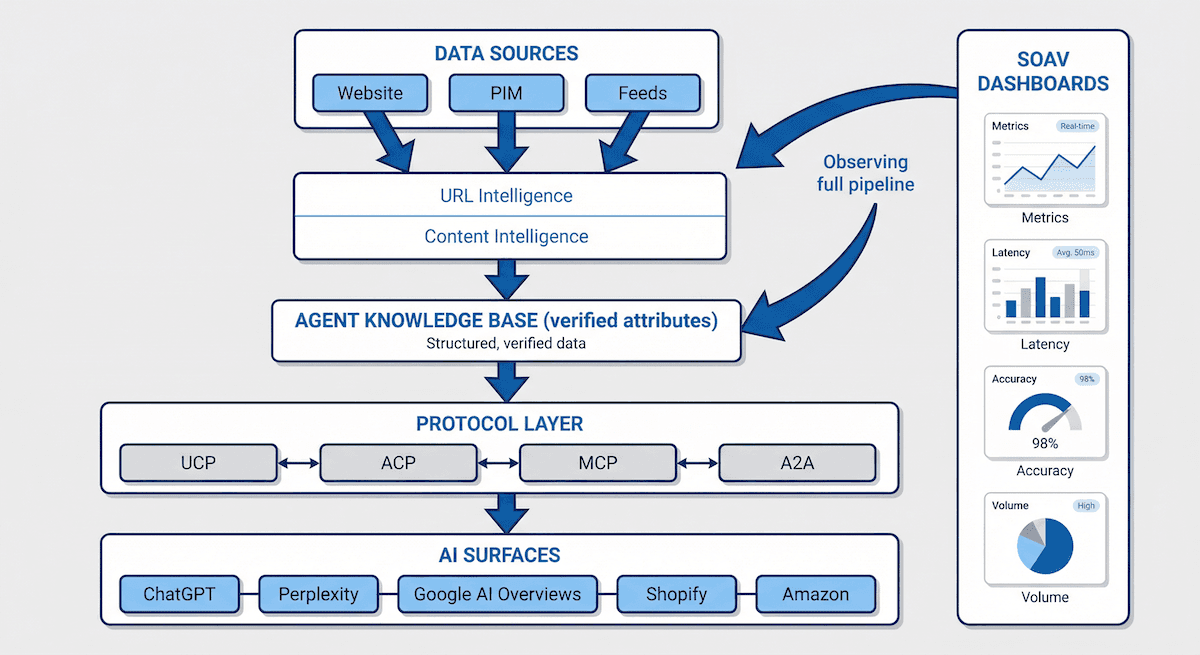
Unified AI Shopping Pipeline: Data sources through URL Intelligence and Content Intelligence to Agent Knowledge Base, then via protocol layer to AI surfaces.
Surface Requirements: What Each Needs, Common Gaps, and Fixes
ChatGPT
Needs verifiable product facts, structured attributes, price and availability, policy constraints, and links to source. Common gaps: unstructured descriptions, missing specs, stale price/availability, no canonical source to cite. eLLMo builds a verified Agent Knowledge Base, generates fact-checked content, exposes via modern agent protocols, and keeps price/availability synced.
Perplexity
Needs parseable, citable pages with structured facts, comparison-friendly tables, and up-to-date content. Common gaps: thin or fragmented data, no clear tables, inconsistent schema, slow or blocked pages. eLLMo normalizes attributes, generates schema-rich and table-friendly pages, uses URL Intelligence to improve reachability, and provides continuous monitoring with SOAV.
Google AI Overviews
Needs Product, Breadcrumb, Review, and Offer schema; Merchant Center feeds; accurate price, availability, and reviews. Common gaps: missing or invalid Product/Offer schema, inconsistent identifiers, no review markup, poor canonical signals. eLLMo's Content Intelligence generates and validates schema, produces Merchant Center-aligned feeds, scores and fixes URLs, and normalizes attributes.
Shopify
Needs complete catalog metadata (variants, collections, tags), accurate titles and descriptions, images, and inventory. Common gaps: inconsistent variant data, unclear relationships, stale inventory. eLLMo provides Product Catalog sync and normalization, governance with validation and conflict resolution, and a semantic search-ready catalog.
Amazon
Needs complete listing attributes (GTIN/UPC/EAN), browse nodes, detailed specs, A+ content, and reliable availability. Common gaps: missing identifiers, incomplete bullets/specs, image and policy gaps. eLLMo provides attribute extraction and enrichment, verified fields with audit trails, and consistent, distribution-ready product truth.
Why This Matters
Organic answers are the new shelf space. OpenAI's answer independence policy confirms that ads will not influence organic answers, raising the bar for structured, authoritative product data.
Assistants prefer verifiable, linkable facts. Perplexity systematically cites sources; Google AI Overviews draw on Product, Offer, and Review schema plus Merchant Center feeds.
Most product pages were not built for agents. Common blockers include missing schema, inconsistent specs, stale availability, poor canonicalization, and limited reachability. eLLMo's URL Intelligence and Content Intelligence directly target these issues.
One integration powers every surface. eLLMo distributes verified product truth via UCP, ACP, MCP, and A2A to minimize bespoke work and accelerate deployment, often in under four hours, across ChatGPT, Perplexity, Google AI, and commerce stacks. No replatforming required.
Getting Started: From Messy to Measurable
Connect and Score
Connect your sitemap or product feeds. Run URL Intelligence across four dimensions (semantic relevance, structured data quality, page performance, reachability) to get page-level scores and prioritized fixes. Output: ranked list of pages and exact recommendations to close readiness gaps.
Build the Agent Knowledge Base
Extract and normalize attributes (identity, specs, pricing, availability, reviews, policies) with two-tier verification and confidence scores. Output: verified, conflict-resolved product truth with audit trails.
Generate and Validate Content
Produce AI-optimized descriptions, FAQs, and schema-rich elements that link back to verified attributes, with no hallucinated claims. Output: consistent, machine-readable content aligned to each surface's expectations.
Distribute via Protocols
Publish to agents and commerce ecosystems using UCP, ACP, MCP, and A2A, as well as direct APIs. Output: single integration powering multi-surface discovery and recommendation.
Monitor Share of AI Voice (SOAV)
Track brand and competitor citations across major assistants with prompt-level analytics. Output: measurable visibility and an iteration loop to improve your AI shelf space.
AI Shopping Readiness Checklist
Your roadmap to AI-first commerce
Canonical URLs and consistent slugs
No multi-path duplicates; one canonical URL per product.
Product schema with Offer fields
Include priceCurrency, price, availability; valid BreadcrumbList; Review and AggregateRating where applicable.
Verified identity and specs
Normalized attribute names and units with provenance.
Price and availability synced
Machine-accessible and kept current.
Reviews mapped with provenance
Clear return and shipping policies.
Robots-allowed and fetchable pages
Acceptable LCP, CLS, and TTFB for crawlability.
Merchant Center feed alignment
For Google Shopping and AI Overviews.
Distribution via modern agent protocols
UCP, ACP, MCP, A2A with secure, rate-limited endpoints.
SOAV instrumentation
Cross-surface measurement for visibility tracking.
Example: Agent-Ready Product Object
Illustrative structure (OpenAI Structured Output style), not JSON-LD:
{
"id": "sku-12345",
"name": "Hydrating Daily Moisturizer SPF 30",
"brand": "Acme Skin",
"category": "Beauty > Skincare > Moisturizers",
"attributes": {
"skin_types": ["normal", "dry", "sensitive"],
"key_ingredients_inci": ["Aqua (Water)", "Glycerin", "Niacinamide 4%", "Zinc Oxide 10%"],
"certifications": ["cruelty_free"]
},
"offers": {
"price": 28.00,
"priceCurrency": "USD",
"availability": "InStock"
},
"reviews": {
"aggregateRating": 4.6,
"reviewCount": 312
},
"urls": {
"canonical": "https://www.example.com/products/hydrating-daily-moisturizer-spf-30"
},
"provenance": {
"lastVerified": "2026-02-27T10:00:00Z",
"confidence": 0.98
}
}Key Resources
Explore solutions, use cases, and surface-specific guides to make your brand agent-ready.
Use Cases
Industry playbooks for General Ecommerce, Beauty and Skincare, and more.
Surface-specific guides
Deep dives into ChatGPT, Perplexity, Google AI, Shopify, and Amazon.
Frequently Asked Questions
What makes a product page agent-ready?
Verifiable attributes, complete Product/Offer/Review signals, canonical reachability, and distribution over agent protocols so assistants can parse, cite, and transact.
Does eLLMo require replatforming?
No. eLLMo integrates with your existing site, feeds, and commerce stack. Most brands deploy in under four hours.
How do we measure performance beyond SEO?
Use SOAV dashboards to track brand and competitor citations and answer share across ChatGPT, Perplexity, Google AI, and more.
How does eLLMo prevent hallucinated product claims?
Content Intelligence generates descriptions and FAQs that are fact-checked against the verified Agent Knowledge Base, with provenance and audit trails.
Which protocols are supported?
UCP, ACP, MCP, and A2A, plus direct API integrations for distribution to agents and commerce ecosystems.
What are the most common blockers to AI visibility?
Missing or invalid schema, inconsistent specs, stale price/availability, duplicate URLs, poor page performance, robots restrictions, and lack of machine-readable facts.
How does this relate to Google AI Overviews?
Overviews rely on structured, high-quality data (Product, Offer, Review, BreadcrumbList) and Merchant Center feeds. eLLMo generates, validates, and aligns both.
Will ads change organic answers in ChatGPT?
OpenAI states answer independence: ads will not influence organic answers. This increases the importance of authoritative, structured product data.
Where should we start if our catalog is messy?
Connect your sitemap, run URL Intelligence, fix the highest-impact pages first, build the Agent Knowledge Base, generate validated content, then distribute and monitor SOAV.
Get AI-Ready
Make your products discoverable across every AI shopping surface from one integration.