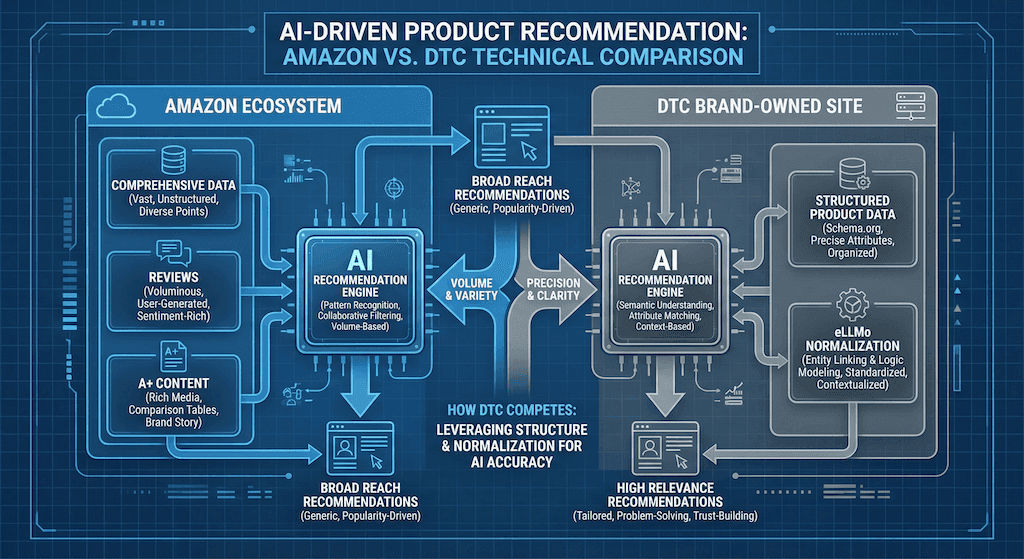
How Amazon Recommends Products — AI Shopping Visibility
Learn how Amazon discovers and recommends products using semantic relevance, structured attributes, offer competitiveness, and behavioral signals. Mirror Amazon-critical fields on your DTC site with eLLMo normalization to win AI recommendations.
How Amazon Discovers and Recommends Products
This page is for ecommerce leaders, product managers, and SEO/engineering teams who need a clear, technical view of how Amazon discovers and recommends products—and how to compete on AI shopping surfaces.
Amazon surfaces products across several discovery contexts:
- Search: Deep-learning relevance models match queries to titles, bullets, and attributes; Amazon reports adversarial training improves this matching.
- Browse: Correct category/browse nodes unlock eligibility in filters and curated category placements.
- PDP Carousels: "Frequently bought together," "Similar items," and related lists depend on co-view/co-purchase and attribute similarity.
- Featured Offer (Buy Box): Competitive landed price, Prime/FBA eligibility, and strong seller performance drive eligibility.
- Sponsored: Paid placements operate alongside organic discovery; this page focuses on organic mechanics.

Mirror Amazon-critical fields on your DTC site with eLLMo normalization to win AI recommendations.
Data Signals Amazon Relies On
Text relevance
Title, bullets, description, backend search terms. Establishes semantic match to user intent.
Structured attributes
Brand, category/browse node, variation (size/color), GTIN/UPC/EAN, ASIN linkage. Enables precise catalog matching, filters, eligibility in browse.
Offer-level signals
Price, availability, shipping speed, Prime/FBA eligibility. Drives Buy Box eligibility and conversion propensity.
Behavioral signals
CTR, add-to-cart, conversion rate, returns. Reinforces listings that satisfy users.
Quality signals
Reviews/ratings volume and recency, image compliance. Impacts trust and CTR; A+ Content supports conversion.
Seller performance
Order defect rate, cancellation, late shipment. Impacts Featured Offer eligibility.
Structured Product Data: DTC vs. Amazon Field Mapping
Amazon's models perform best when catalog fields are comprehensive, normalized, and unambiguous. Use the mapping below so your brand-owned site mirrors these fields and AI assistants can cite you—not just Amazon.
| Amazon field | Your DTC equivalent | eLLMo normalization |
|---|---|---|
| Title + bullets | H1 + structured feature bullets | Attribute extraction and canonicalization |
| Category/browse node | Product type taxonomy | Category normalization for agent protocols |
| Brand, GTIN/UPC/EAN, MPN | brand, gtin, sku, mpn | Identity reconciliation; variant linking |
| Price + availability | Price, inventory status | Real-time sync; availability proofing |
| Images (primary + gallery) | Optimized alt-text and captions | Asset metadata extraction |
| A+ Content | Long-form narrative/FAQ | Fact-checked narrative from verified attributes |
Minimum viable structured data for AI shopping: Identity (brand, model, GTIN/UPC/EAN, SKU, canonical URL); core specs; commercials (price, currency, availability, shipping, returns); compliant main image + 2–5 gallery; concise bullets + fact-checked description; precise product type; machine-readable policy hooks.
Example: Product Microdata on Your PDP
Use schema.org Product as HTML microdata (or JSON-LD). eLLMo can deploy structured data at publish.
<div itemscope itemtype="https://schema.org/Product">
<h1 itemprop="name">Acme Hydrating Serum 30ml</h1>
<meta itemprop="gtin13" content="0123456789012">
<meta itemprop="sku" content="AC-HS-30ML">
<img itemprop="image" src="/images/acme-serum.jpg" alt="Acme Hydrating Serum bottle" />
<div itemprop="offers" itemscope itemtype="https://schema.org/Offer">
<meta itemprop="priceCurrency" content="USD" />
<span itemprop="price">28.00</span>
<link itemprop="availability" href="https://schema.org/InStock" />
</div>
</div>Common Reasons Products Fail to Appear
Your roadmap to AI-first commerce
Incomplete identity fields
Missing GTIN/UPC/EAN or brand inconsistencies prevent correct catalog matching.
Wrong category/browse node
Misclassification blocks eligibility in browse paths and filters.
Offer non-competitiveness
Uncompetitive price, slow shipping, or OOS reduces ranking and Featured Offer eligibility.
Poor listing quality
Non-compliant images, thin bullets/description, inconsistent attributes.
Weak social proof
Low review volume/recency or poor ratings depress CTR and conversion.
Variation misuse
Incorrect parent/child relationships fragment relevancy and inventory.
Seller performance issues
High order defect or late shipment rates disfavor Buy Box.
Policy opacity
Unclear shipping/returns reduce agent confidence to recommend.
Duplicate/conflicting records
GTIN collisions or duplicate SKUs confuse catalog linkage.
Quick Triage Checklist
Your roadmap to AI-first commerce
Identity complete (brand, GTIN/UPC/EAN, SKU) and unique
Unique identifiers for catalog matching.
Category/browse node correct and consistent with attributes
Correct classification for browse eligibility.
Price and fulfillment competitive vs. nearest peers
Competitive offers improve ranking.
Images meet compliance; bullets cover top decision attributes
Listing quality drives CTR and conversion.
Reviews volume and recency sufficient for category norms
Social proof builds trust.
Variations correctly modeled; inventory synced
Parent-child relationships for variants.
Policies machine-readable; no contradictions across pages
Consistent shipping and returns data.
How eLLMo Helps
eLLMo converts your existing site and PIM into an agent-ready, verified product truth so AI assistants—and external models—can parse, cite, and transact with confidence. No replatforming.
URL Intelligence: Discovers and scores every PDP across semantic relevance, structured data quality, performance, and reachability (1–100). Identifies exactly what to fix first.
Agent Knowledge Base (Product Intelligence): Extracts, verifies, and enriches product data (identity, composition, specs, pricing, availability, variants) with confidence scores and audit trails. Outputs compatible with UCP, ACP, MCP, A2A.
Content Intelligence: Generates fact-checked descriptions and FAQs grounded in verified attributes—no hallucinated claims.
SOAV (Answer Engine Optimization): Measures your Share of AI Voice across ChatGPT, Perplexity, Google AI Overviews—so you see when Amazon is cited instead of you.
Product Catalog: Real-time sync from website or PIM; validation, conflict resolution, and governance controls.
Implementation Workflow (No Replatforming)
Automated discovery, extraction, verification
1–2 hours with confidence scoring.
Review prioritized fixes from URL Intelligence
Apply highest-impact changes first.
Publish fact-checked content; expose verified catalog via protocols/APIs
UCP, ACP, MCP, A2A.
Frequently Asked Questions
Does schema.org on my site help my Amazon visibility?
Indirectly. Amazon primarily uses its internal catalog. Rich, accurate schema.org on your DTC site improves AI assistant citations and external signals.
What's the difference between ASIN and GTIN/UPC?
ASIN is Amazon's internal identifier. GTIN/UPC/EAN are global identifiers. Accurate GTIN mapping improves catalog deduplication and variation linking.
How do I get the Buy Box (Featured Offer)?
Maintain competitive landed price, reliable fulfillment (Prime/FBA helps), and strong seller performance. See Seller Central performance guidance.
Why do my products vanish from browse filters?
Misclassification or missing attributes. Ensure category and variation fields are complete and consistent.
How do I compete with Amazon in AI answers?
Expose verified, structured product truth on your site; normalize identity and specs; publish fact-checked content; and measure citations with SOAV. eLLMo centralizes this without replatforming.
Will FBA always improve visibility?
FBA/Prime eligibility often correlates with improved offer competitiveness. It's not a guarantee; price, availability, and performance still matter.
How long to see impact after fixing data?
Listing updates can reflect quickly, but behavioral improvements (CTR, reviews, conversion) accrue over weeks.
Can eLLMo distribute my catalog to agent protocols without changing my stack?
Yes. eLLMo supports UCP, ACP, MCP, and A2A, plus direct APIs—no replatforming.
Which attributes are non-negotiable?
Brand, GTIN/UPC/EAN, correct category, price, availability, and compliant images.
How do I track when Amazon is cited instead of my site?
Use eLLMo's SOAV dashboards to monitor assistant answers and prioritize improvements.