How AI Discovers Shopify Products — AI Shopping Visibility
How AI discovers Shopify products via direct crawl, merchant feeds, and Catalog APIs (ChatGPT Instant Checkout, Perplexity Buy with Pro). What structured product data matters and how eLLMo integrates in ~30 minutes.
How AI Discovers Shopify Products
This page is for Shopify engineering, SEO, and merchandising teams who need a precise, implementation-focused guide to how AI shopping surfaces find, understand, and recommend products.
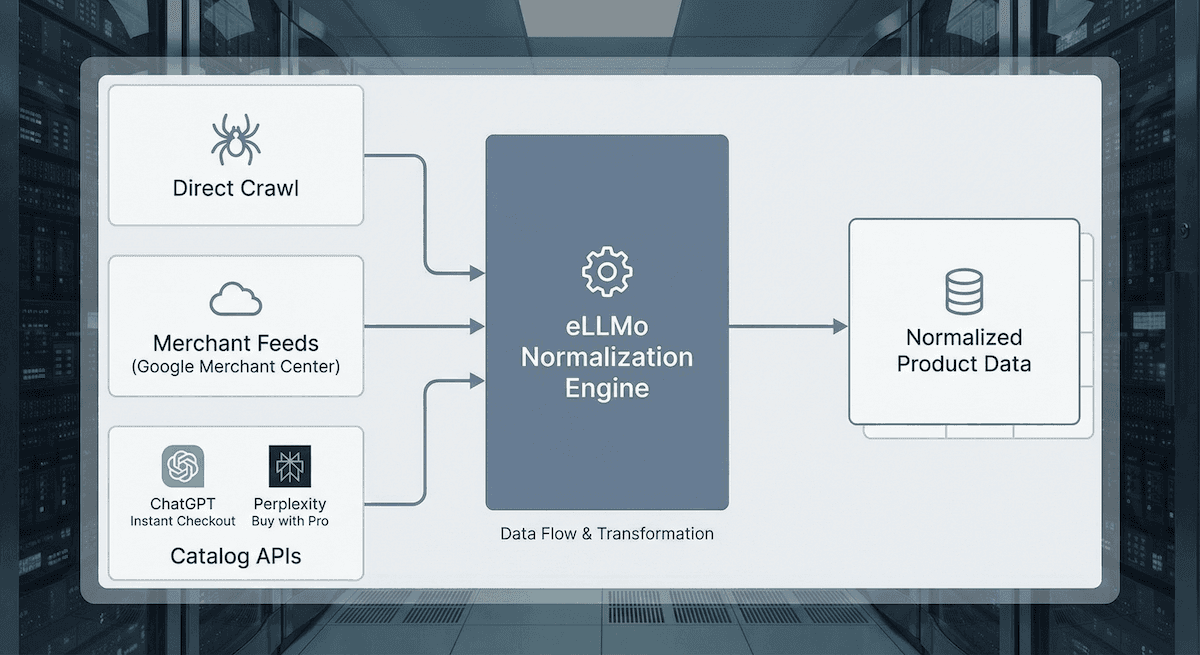
AI shopping surfaces reach Shopify catalogs in three primary ways:
1) Direct crawl: AI assistants and search engines crawl public PDPs and collections, respecting your robots.txt. Dependencies: crawlable links, canonicalization, structured data, fast pages.
2) Merchant product feeds: Surfaces ingest your product feed (e.g., Google Merchant Center spec) to unify identity, pricing, and availability. Dependencies: accurate GTIN/brand/MPN, price/availability consistency with PDP, image quality.
3) Catalog APIs (agentic commerce): Surfaces consume near-real-time product truth via catalog integrations and protocols. ChatGPT Instant Checkout and Perplexity Buy with Pro introduce in-chat product selection and checkout for select merchants.

Three discovery paths to Shopify catalogs for AI surfaces.
Data Signals That Matter for Shopify
Identity and normalization
SKU/variant ID, brand, GTIN/UPC/EAN, MPN. Parent-child variant relationships (color/size/material).
Offers and commerce readiness
Price, currency, priceValidUntil, availability with timestamps. Shipping/returns (OfferShippingDetails, MerchantReturnPolicy).
Content quality and semantics
Title, description aligned to attributes. Ingredient/spec fields, dimensions, materials. Alt text for images; 1200px+ preferred for product hero.
Provenance and consistency
Cross-source consistency (PDP, feed, API). Canonical URLs, hreflang (if multi-region), breadcrumbs.
Crawl and page health
robots.txt allow rules for bots you want indexing. Core Web Vitals, render integrity (SSR/edge caching preferred).
Citations and trust signals
Editorial reviews, ratings (with source), policy pages. First-party authority (brand graph).
Signal-to-Source Implementation Checklist
Your roadmap to AI-first commerce
SKU/GTIN/MPN present and unique
Unique identifiers for each product and variant.
Offer has price, currency, availability, validity window
Complete commercial data for commerce readiness.
Product JSON-LD includes Product and Offer (or AggregateOffer)
Schema.org structured data on PDP.
PDP price/availability match feed and API output
Consistency across all surfaces.
Images 1200px or larger, non-watermarked primary, descriptive alt text
Compliant imagery for rich results and accessibility.
robots.txt allows major crawlers
Disallow only true private paths.
Canonical stable; no multi-path duplicates
Single canonical URL per product.
Returns/shipping policies machine-readable and linked
Structured policy data for agent trust.
Structured Product Data: Product + Offer JSON-LD
Focus on schema.org Product/Offer, feed compliance, and live catalog exposure. Keep all three consistent. Required: name, sku, gtin, brand, offers (price, priceCurrency, availability, url), primary image, canonical url. Include hasMerchantReturnPolicy and shippingDetails for commerce readiness. Reference Google's Product structured data for required/optional fields.
Common Reasons Products Fail to Appear
Your roadmap to AI-first commerce
robots.txt blocks essential crawlers or image folders
Prevents discovery by AI and search crawlers.
Price or availability mismatch between PDP and feed/API
Causes disapproval or demotion.
Missing GTIN where expected; ambiguous identity across variants
Confuses catalog matching and deduplication.
Thin or noisy schema
Product without Offer, or missing availability.
Low-quality or missing primary images
Or non-resolving image URLs.
Multiple canonicals for the same PDP
Multi-path duplicates, collection parameterization.
Slow or unreliable PDP rendering
Hydration failures hide content from bots.
Faceted crawl traps
Infinite filter URLs consuming crawl budget.
How eLLMo Helps
eLLMo AI is an agentic commerce translation layer that makes your Shopify catalog discoverable, trustworthy, and transactable across AI surfaces without replatforming.
Product Intelligence: Extracts and verifies product attributes from PDPs and feeds; normalizes identity (SKU, GTIN, variants) and vertical-specific specs. Two-tier verification and confidence scoring.
Product Catalog: Centralized, real-time, structured catalog with governance (validation, conflict resolution, audit trails) and semantic embeddings. Syncs from Shopify and/or PIM; live inventory and pricing updates.
URL Intelligence: Scores every PDP for semantic relevance, structured data quality, performance, and reachability.
Distribution: UCP, ACP, MCP, A2A, and direct APIs so any agent (ChatGPT, Perplexity, Google AI) can consume verified catalog truth. SOAV dashboards measure citations and competitive benchmarks at prompt level. Implementation: Connect Shopify in about 30 minutes; enrichment 1 to 2 hours; protocol deployment same day.
Implementation Timeline
Connect Shopify or PIM
About 30 minutes.
Enrichment and normalization
1 to 2 hours.
Protocol deployment and monitoring
Same day. No migration or downtime; works with your existing checkout stack.
Frequently Asked Questions
Does adding Product/Offer schema guarantee inclusion?
No. Schema improves machine understanding but must be consistent with feed/API, resolve cleanly, and pass quality checks (images, crawlability, page health).
What's the fastest way to fix price mismatch disapprovals?
Make your PDP price and microdata/JSON-LD authoritative; ensure the feed derives from the same source of truth. eLLMo enforces cross-surface price coherence.
How often should I refresh availability?
Near real-time for fast-moving SKUs. eLLMo syncs from Shopify and exposes freshness to consuming agents.
Can I block some bots but still be visible in AI shopping?
Yes, but block intentionally. Don't block primary PDPs or images. Use Shopify robots.txt.liquid to control paths.
Do I need GTINs for all products?
Strongly recommended where applicable. Use brand+MPN when no GTIN exists.
Will headless or heavily scripted PDPs hurt AI discovery?
They can, if content is not reliably rendered to crawlers. Prefer server-side or edge-rendered content.
How does eLLMo measure Share of AI Voice?
SOAV dashboards track citations and mentions across assistants by query intent, compare against competitors, and map wins/losses to specific PDP/attribute gaps.
Do membership pricing and promotions work with AI surfaces?
Yes, if exposed as structured, policy-guarded offers. eLLMo can model promotions and membership rules so agents present correct terms.