How Google AI Overviews Surface Products — AI Shopping Visibility

Learn how Google AI Overviews discover and synthesize product recommendations from organic content (not Shopping ads). Schema, modular content, FAQs, and extractability drive visibility.

eLLMo Team
eLLMo Team
12 min read

How Google AI Overviews Discover Products

This page is for technical SEOs, ecommerce engineers, and digital product teams who want to understand how Google AI Overviews discover and synthesize product recommendations from organic content (not Shopping ads).

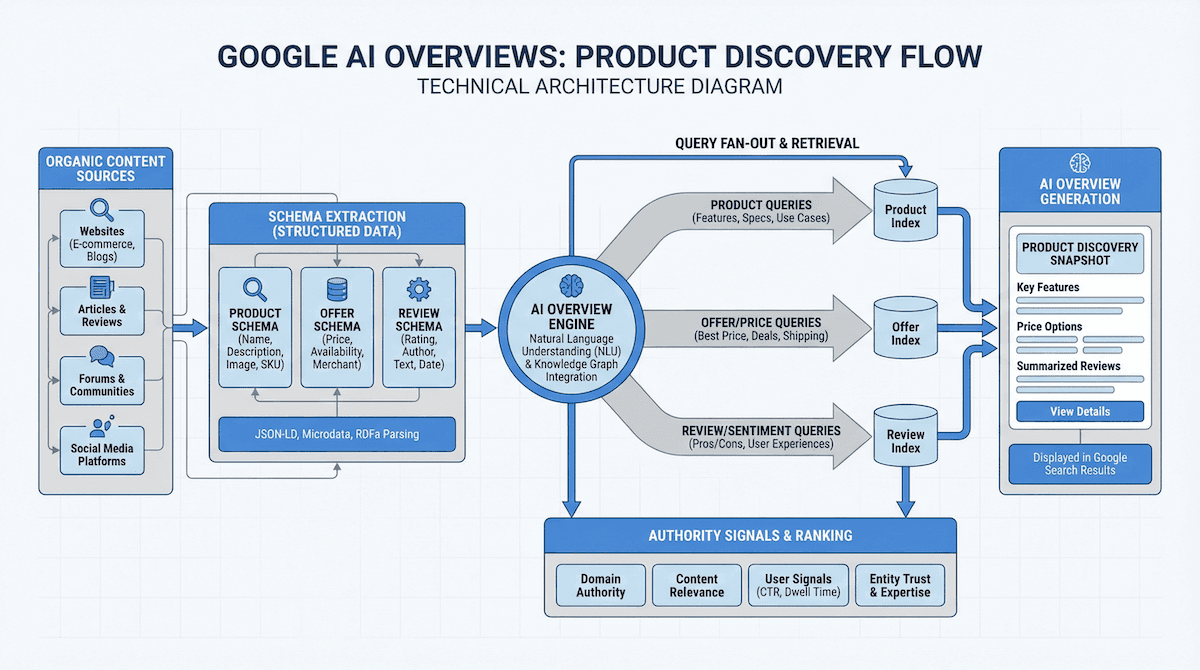
For shopping queries, AI typically: fans out across topically relevant, crawlable pages; extracts facts from structured data (schema.org) and machine-readable modules (spec tables, FAQs); cross-checks consistency across sources; and prioritizes extractable content blocks over keyword-only copy.

Key implication: AI Overviews are not ad placements. Eligibility depends on organic content quality, structured data, and extractability. Clear Page Purpose plus Machine-Readable Facts plus Freshness yield better inclusion odds.

Google AI Overviews product discovery flow from organic content and schema to synthesized answers.

How Google AI Overviews synthesize product recommendations from organic content.

Data Signals That Matter for Google AI Overviews

Structured data quality

Product, Offer, AggregateRating/Review, Breadcrumb. Valid, current, consistent across PDPs. Canonicals and one-URL-per-concept prevent duplication.

Extractable content blocks

Specification tables with normalized units and labeled fields. FAQ sections with concise paragraphs. Modular headings and lists.

Freshness and availability

Price and availability up-to-date; no stale Offers. Versioned or timestamped content for change visibility.

Page performance and reachability

Crawlable links, stable HTML, render reliability. Fast LCP and minimal CLS to reduce parsing issues.

Authority and consistency

Cross-page alignment (PDP, comparison, policy pages). Clear brand identity and product identifiers (SKU, GTIN).

Structured Product Data: What This Surface Needs

Implement schema.org in JSON-LD with verified values. Product with nested Offer and AggregateRating. Provide identifiers (SKU, GTIN) and normalized attributes via PropertyValue. Keep price/availability current; remove expired priceValidUntil. Only publish reviews you can substantiate. Use BreadcrumbList to reinforce page hierarchy.

Use Google Rich Results Test to validate. Ensure values match visible content to avoid discrepancies.

Common Reasons Products Fail to Appear

Your roadmap to AI-first commerce

1

Shallow, non-extractable content

Single long paragraph, no headings, no spec table, no FAQs.

2

Missing or invalid schema

Product without Offer; prices stale, availability missing, or invalid currency codes.

3

Conflicting values across pages/feeds

PDP vs. comparison page shows different sizes or ingredients.

4

Multi-path duplicates and weak canonicalization

Same PDP at multiple URLs; no canonical or inconsistent canonicals.

5

Render or reachability issues

JS-gated content; blocked resources; slow LCP; intermittent 5xx.

6

Keyword-only optimization

Repetition without machine-readable facts and attributes.

To stay up to date, follow us on LinkedIn and sign up to our mailing list via our mailing list.

Quick Triage Checklist

Your roadmap to AI-first commerce

1

One canonical PDP URL per product

No multi-path duplicates.

2

Valid Product + Offer + AggregateRating/Review schema

On PDP.

3

Extractable modules: spec table + FAQ + modular headings

Machine-readable content blocks that AI can reliably parse.

4

Fresh price/availability

Automated sync from source of truth.

5

Breadcrumbs reflect site hierarchy

Clear navigation structure for crawlers and users.

6

Page passes Rich Results Test

Validates structured data and core crawlability.

To stay up to date, follow us on LinkedIn and sign up to our mailing list via our mailing list.

How eLLMo Helps

URL Intelligence: Auto-discovers product URLs from sitemaps and scores each page for semantic relevance, structured data quality, performance, and reachability. Prioritize pages most likely to be cited by AI assistants.

Product Intelligence: Extracts, verifies, and enriches data into vertical-specific fields. Outputs compatible with UCP/ACP/MCP/A2A, forming your Agent Knowledge Base.

Content Intelligence: Generates fact-checked, AI-optimized content and schema modules (descriptions, FAQs, spec tables) tied to verified attributes. No hallucinated claims.

Answer Engine Optimization (SOAV): Monitors share of AI-generated answers and citations across platforms including Google AI Overview. Typical deployment under four hours; no replatforming.

Implementation Steps

1

Audit

Run URL Intelligence to score PDPs for extractability and structured data quality.

2

Normalize

Use Product Intelligence to build a verified product knowledge base.

3

Author

Generate schema-rich PDP modules with Content Intelligence (spec tables, FAQs).

4

Validate

Confirm Product/Offer/Review/Breadcrumb markup in Rich Results Test.

5

Monitor

Track Share of AI Voice (SOAV) for shopping queries and adjust.

Frequently Asked Questions

How do Google AI Overviews choose products to cite?

They synthesize from organic results, prioritizing extractable, verifiable facts (Product/Offer/Review schema, spec tables, FAQs) and consistent signals across reputable pages.

Do I need Google Merchant Center for AI Overviews?

No. AI Overviews synthesize organic content. Merchant Center helps in other contexts (ads, free listings) but is separate from AI Overview eligibility.

Which schemas are essential?

Product, Offer, and Review/AggregateRating are foundational, with BreadcrumbList for hierarchy clarity.

How often should I update price and availability?

As frequently as it changes. Stale Offers reduce trust. Automate updates from your source of truth.

How does eLLMo keep generated content accurate?

Content Intelligence is fact-checked against your Agent Knowledge Base (verified attributes), eliminating hallucinated claims.

What if my PDPs exist at multiple URLs?

Consolidate to a single canonical per product and remove alternate paths. Multi-path duplicates fragment signals.

Does page speed matter?

Yes. Slow or unstable rendering affects crawl, render, and extraction reliability.

Can eLLMo track my visibility in AI Overviews?

Yes. Answer Engine Optimization (SOAV) tracks citations and mentions across major AI platforms including Google AI Overview.

Join Our Mailing List

Stay tuned. Join our mailing list to be among the first to experience the future of search. We'll be in touch with news and updates.

We respect your privacy. Unsubscribe at any time.