How Perplexity Recommends Products — AI Shopping Visibility
Learn how Perplexity finds and recommends products with citation-forward, real-time web search. What data signals matter, why products fail to appear, and how extractable content gets you cited.
How Perplexity Discovers and Recommends Products
This page is for technical SEO leads, ecommerce engineers, and product managers who need to understand how Perplexity finds and recommends products, and how to structure product data so it's parsed, cited, and recommended.
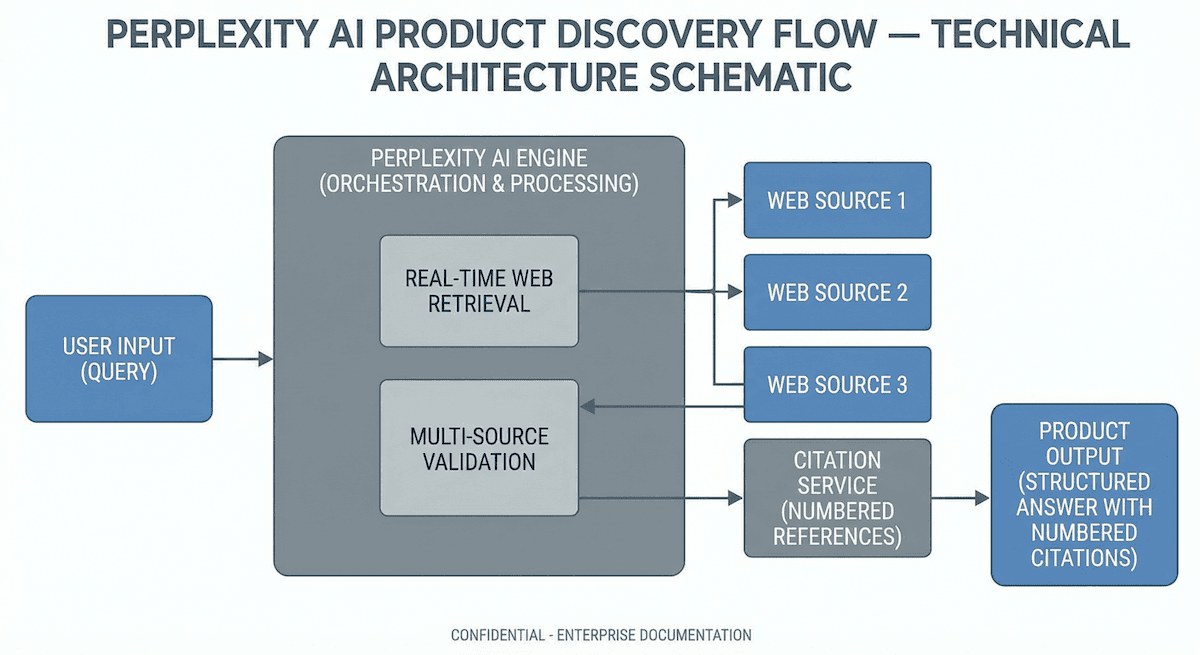
Perplexity uses real-time web retrieval with a citation-forward UX. Answers include numbered citations linking to source pages so users can verify claims. For complex queries, Pro Search deepens retrieval. For shopping prompts, users see product cards; Perplexity Pro (U.S.) supports Buy with Pro for select merchants with a rolling Merchant program.
Ranking reflects extractability, consistency, and authority. Content in extractable formats (HTML spec tables, ordered lists, FAQs) performs best.

Real-time web retrieval, multi-source validation, numbered citations.
Data Signals Perplexity Relies On
Structured facts
HTML spec tables, ordered lists, definition lists for easier field extraction for product cards and comparisons.
Q&A blocks
Clear FAQs with concise answers. Add 6 to 10 high-intent FAQs per PDP for direct-answer extraction.
Cross-source consistency
Specs, names, claims consistent across brand, marketplace, and reviews. Conflicting facts reduce citation likelihood.
Freshness
Visible Last updated; frequent catalog refresh. Perplexity prioritizes up-to-date information.
Crawlability and performance
Reachable URLs, minimal client-side blocking, fast TTFB. Ensures pages can be fetched and parsed reliably.
Schema presence
Product, Offer, FAQPage, Breadcrumb improve machine readability and corroboration.
Authority
Reputable domain plus internal evidence and references. Build topical hubs and internal link scaffolding.
Structured Product Data: Extractable Patterns
1) Extractable overview: Keep a 2 to 3 sentence summary with a definition of the product/category and a short best-for line above the fold.
2) Accessible spec table: Use stable class names; no JS-dependent rendering. Semantic HTML with caption, thead, tbody, and scope attributes.
3) FAQ block: Concise, direct answers. Structure as article/h3/p for each Q&A.
4) Breadcrumbs and canonical: Clear nav with aria-label; link rel canonical.
5) Crawlability: robots.txt allows crawlers; sitemap discoverable. Avoid JS-only rendering.

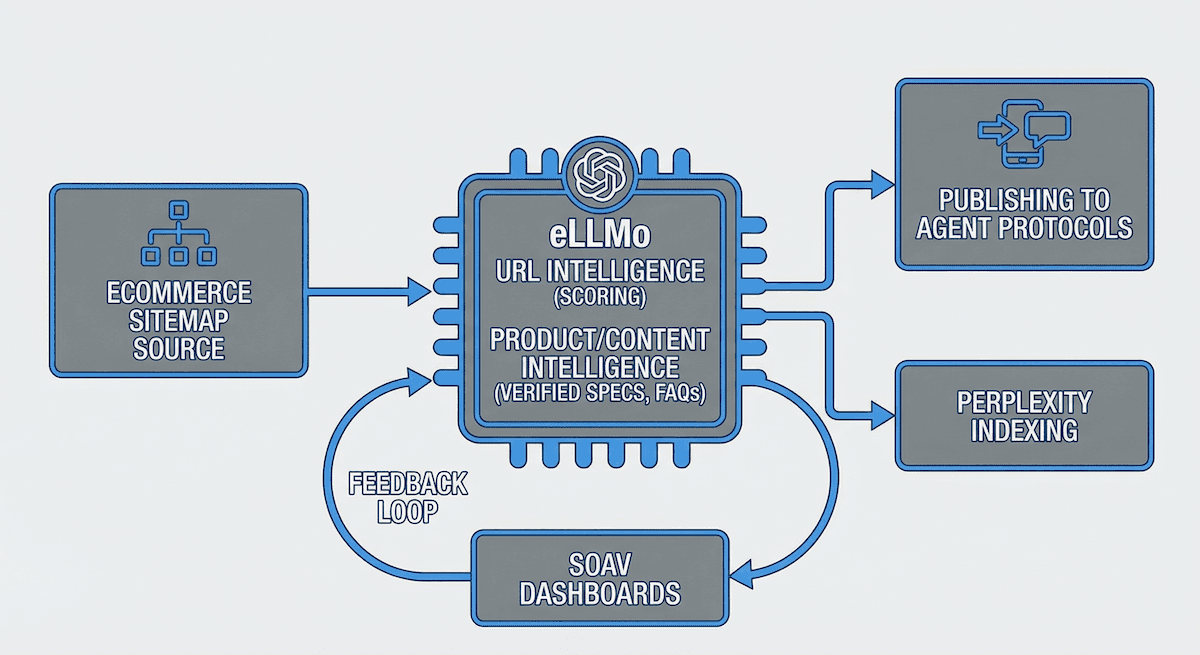
eLLMo to Perplexity data path with SOAV dashboards.
Common Reasons Products Fail to Appear
Your roadmap to AI-first commerce
Specs in images or PDFs instead of HTML tables
Use extractable HTML tables.
Inconsistent model names/specs across sources
Normalize and sync across brand, retailer, and review sites.
No clear FAQs or direct answers
Add 6 to 10 high-intent FAQs per PDP.
Missing price/availability or stale last updated
Expose modified timestamps; automate updates.
Robots or complex JS prevents fetching
Ensure robots allowlist; avoid JS-only render.
Slow TTFB/LCP degrading crawl
Optimize performance for extraction reliability.
No breadcrumbs/canonical; overlapping URLs
Clear canonical; hub-and-spoke breadcrumbs.
Schema contradicts visible content
Keep schema aligned to visible facts.
How eLLMo Helps
URL Intelligence: Auto-discovers all PDPs from your sitemap and scores each URL (1 to 100) on reachability, semantic relevance, structured data, and performance. Outputs prioritized, actionable fixes.
Product and Content Intelligence: Extracts and verifies product attributes with enterprise-grade accuracy; generates fact-checked, AI-optimized descriptions and FAQs tied to verified fields. Prevents hallucinated features.
SOAV (Answer Engine Optimization): Tracks Share of AI Voice across Perplexity, ChatGPT, Gemini, and Perplexity-like surfaces with prompt-level analytics. One integration, no replatforming.
Next Steps
Explore the AI Shopping parent hub, improve extractability with URL Intelligence, build a verified catalog with Product Intelligence, and track Share of AI Voice with AEO dashboards.
Frequently Asked Questions
Does Perplexity use real-time web search?
Yes. Perplexity performs live retrieval and includes numbered citations to sources in its answers.
Will Product and FAQ schema help?
Yes. Product/Offer and FAQPage improve machine readability. Ensure structured data mirrors visible facts.
What's Pro Search and why does it matter?
Pro Search expands retrieval depth for complex queries, improving the chance that thorough, structured PDPs get cited.
How do product cards and Buy with Pro work?
For shopping queries, Perplexity can render product cards; Pro users in the U.S. can Buy with Pro from select merchants.
Why isn't my product cited even though it ranks in organic search?
Common causes: specs in images/PDF, inconsistent facts across sources, no direct-answer FAQs, blocked crawling, or JS-only rendering.
How do I measure if Perplexity is citing my brand?
Use SOAV dashboards (Answer Engine Optimization) to track Share of AI Voice and citation quality across major assistants.
Do I need to replatform?
No. eLLMo integrates with Shopify, WooCommerce, WordPress, and custom stacks.
What's the fastest way to improve extractability?
Standardize HTML spec tables, add concise FAQs, expose Last updated, and ensure clean breadcrumbs and canonical URLs.
Can eLLMo help with cross-source contradictions?
Yes. Product Intelligence normalizes and verifies attributes; Content Intelligence generates descriptions/FAQs that reflect verified facts.