An answer engine read a kids' shoe page. It came back with twenty fields and none of the answers a parent asks for.
We took one product page, a red patent slip-on for kids, and compared what a parent sees in a browser with what an answer engine took away from it. The engine got a table: name, price, material, sizes, shipping. It got no review words, no fit advice, no use cases, and nothing about who the shoe is not for. Those are the questions a parent asks an engine. That distance is the missing revenue.
On November 4 we looked at one product page two ways. First in a browser with every script run, which is the page a parent sees. Then the way an answer engine sees it: the page loaded without JavaScript, then read as text and reduced to the facts the engine could extract. That is how answer engines evaluate a page before they decide whether to mention it.
The page is a red patent slip-on for kids, priced at $50, from Floafers. We chose it because it is an ordinary, well-kept page on a mainstream platform. Nothing on it is broken. The gap we found is the normal one.
The baseline: what a parent sees
In a browser the page does a good job. Nine photos. A 4.7 rating from 588 reviews with a bar for each star count: 492 five-star, 32 four, 35 three, 18 two, 11 one. A size picker from C4 to J4. An AI-written summary of the reviews, then the reviews themselves, each dated and stamped Verified Buyer, with filters by topic: size, fit, color, shipping, material. The store has replied under some of them. Three photo panels tell the story: a boy who put them on himself, a shoe being rinsed in a sink, a kid on a climbing frame. Three related colors sit below at $50 marked down from $60. A points offer, a refer-a-friend offer, a size guide in inches and centimeters.
A parent can answer most of their questions on this page. Not from the fields, but from the reviews, the photos, the filters and the replies. That layer is the sale.
The same page without JavaScript
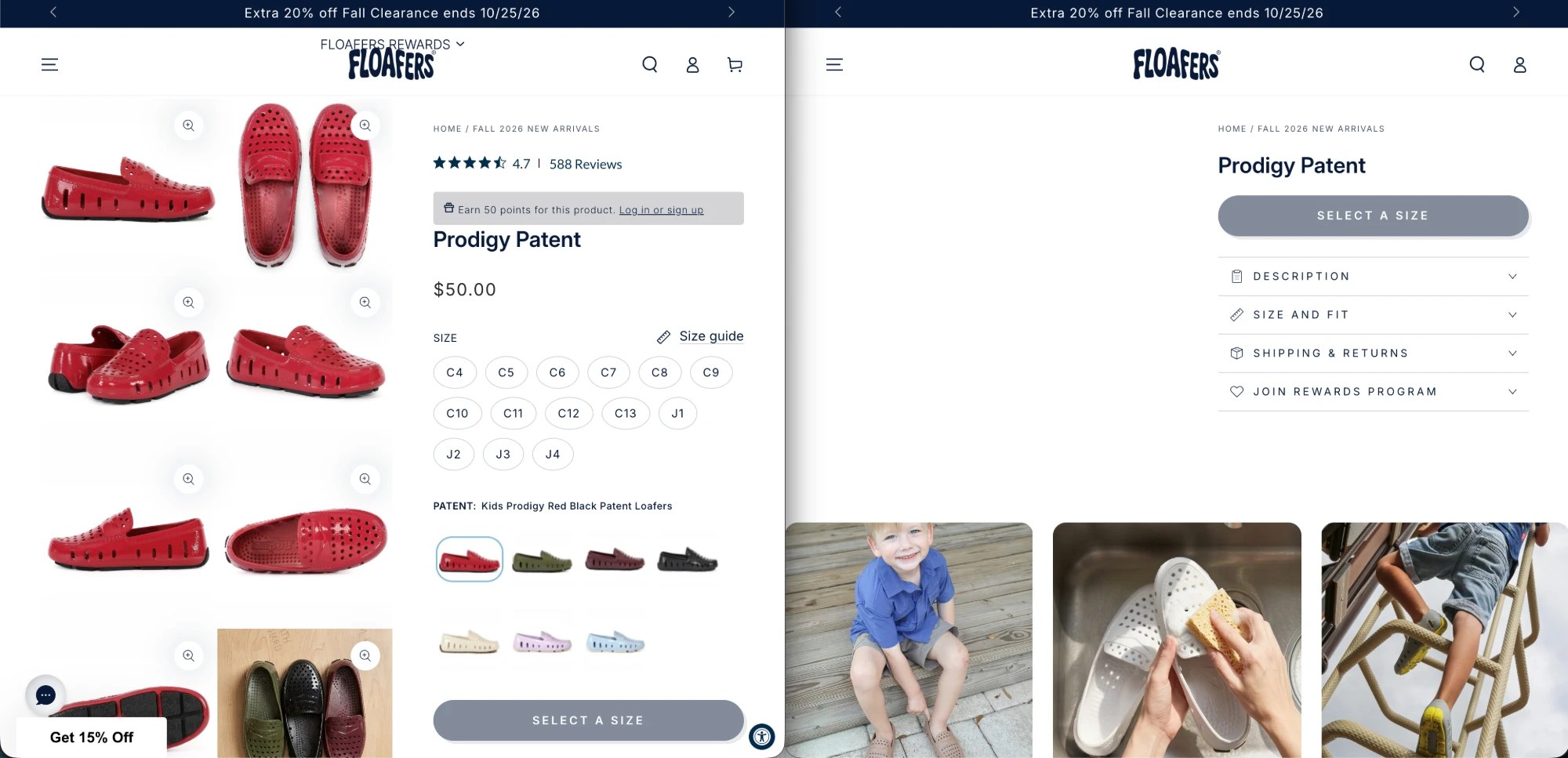
Now switch the scripts off. This is the first thing an answer engine sees when it fetches the page, before any extraction happens. The screenshot below is this page, with JavaScript on the left and off on the right.
On the left, eight photos, 4.7 from 588 reviews, $50, fourteen sizes, seven colors and a points offer. On the right there are no photos. No price. No rating and no review count. No size picker and no color swatches. No points offer. What is left is the breadcrumb, the name, a grey button that cannot be pressed, and four closed drawers labeled Description, Size and Fit, Shipping and Returns, Join Rewards Program. The three story panels survive below the fold because they are plain images with plain captions.
The gallery, the price block, the rating widget, the size picker and the swatches are all drawn by scripts. The words behind some of them exist in the document, which is why the engine can still pull a spec sheet out of it. But the page, as a page, is gone. The engine is reading a frame and guessing at the picture.
What the engine took away
We then asked an answer engine to read the same page and report what it found. It had about 370 lines of text to work with and came back with a table of roughly twenty fields.
- Product name Prodigy Patent, with the tab title Kid's Prodigy Driver Foam Shoe | Patent Red/Black.
- Type and color Children's slip-on loafer, Red/Black.
- Price $50.00.
- Sizes C4 to C13 and J1 to J4, and a listed range of Toddler 4 through Kids 3, whole sizes only.
- Material, sole, closure Antimicrobial EVA foam with a glossy patent finish, non-slip rubber outsole, slip-on.
- Claims Waterproof, scuff-resistant, antimicrobial, vegan. Care: wipe with a damp cloth and air dry.
- Shipping and returns Free U.S. shipping over $80, USPS flat rate at $6.95, FedEx 2-Day Air at $28.50, returns within 60 days if unworn.
- Reviews An overall rating of 4.6592846 out of 5 from 587 reviews.
- Images Nine image entries.
- Positioning Suitable for school, formal occasions and everyday use. Waterproof, easy to clean, resists scuffing.
That is a spec sheet. It is accurate as far as it goes. Now put it next to the baseline and look at what fell out.
What fell out on the way
- Every review word. The engine got a rating with seven decimal places and a count. It got zero sentences from the 587 parents who wrote them. The review widget is built by JavaScript. The plain fallback in the document carries ten excerpts, and the engine still kept none of them. Either way, nothing a parent said reached the engine.
- The rating breakdown. 492 five-star reviews against 11 one-star is a trust signal. A bare 4.66 is a number.
- Verified Buyer badges and dates. Proof that a review is real and recent exists only after the scripts run.
- The AI review summary. The page already carries a machine-written summary that says the shoes are odor-resistant, buoyant, water-friendly and good for active kids. None of it reached the table. The store did the summarizing work and the engine never saw it.
- The store's replies. The first review in the browser is a five-star titled Material is never healthy, with an apology from the store underneath it. The engine saw neither.
- The three story panels. He put them on himself. Rinse them in the sink. Steady on a climbing frame. These are the use cases, and they are the part of the page written for a parent rather than for a spec sheet. They left no trace in the table.
- The customer question. One parent asked when more sizes would be back and the store answered. Gone.
- The related colors and the markdown. Three sibling shoes at $50 marked down from $60, so the family is on sale. The table has one price and no siblings.
- The season. The page lives in a Fall 2026 New Arrivals collection. The table does not know the shoe is new.
- The promotion. A banner reads Extra 20% off Fall Clearance ends 10/25/26, ten days past its date on the day we read it. The engine did not see it, which is lucky, since it is wrong.
The engine kept the facts a catalog needs and dropped the facts a parent needs. The page has both. Only one layer travels.
The questions the table cannot answer
A parent does not ask an answer engine for a spec sheet. They ask a question with their child in it. Here is what the table gives back.
- Which size for my five-year-old? The table has C4 to C13, J1 to J4, and Toddler 4 through Kids 3. Two notations and no ages. The size guide gives inches and centimeters, which is useful if the parent has a ruler and not useful if they have a question.
- Do they run big or small? Nothing. One review in the browser says they run about a half size big. It is the single most useful sentence on the page for a parent and it never reached the engine.
- Can he wear them in the rain, at the pool, to a wedding? Waterproof: yes. That is all. The sink photo, the climbing frame and the school-photo line in the description are the answer, and they arrived as one generic sentence about school, formal and everyday use.
- What is the difference between this and the plain red, or the black patent? Nothing. The page shows the siblings in a browser. The table has one shoe and no family.
- Why is J4 $60 when the rest are $50? The table says $50. The size picker in the browser says J4 is $60. The engine will quote the wrong price for the largest size.
- Is C9 in stock? The table has no stock per size. A Notify Me When Available button sits on the page for whenever a size sells out.
- Who is this shoe not for? Nothing. A page that says who a product suits should also say who should buy something else: wide feet, narrow feet, a child who kicks shoes off, a child who needs laces. A review in the browser says the foam shrinks if left in a hot car. That is the kind of counterfactual an engine needs before it recommends, and it is in a widget the engine cannot read.
- What is a Driver? The tab title and the description both call it a Driver. Nothing on the page says what that means or how it differs from the loafer, the slide or the boot in the same store.
- What do other parents say? 4.6592846 out of 5 from 587 reviews. Not one word.
Nine questions. The table answers one of them cleanly, the care question, and half-answers two. A parent asking any of the rest gets a hedge or a different shoe.
And what did arrive, arrived in copies
The facts that did reach the engine are not always one fact. The tab title says Prodigy Driver, the heading says Prodigy Patent, the structured data says Kids Prodigy Red Black Patent Loafers, and the structured data's brand field reads KIDS, the department, rather than the maker. The size range is given three ways on the page and two of them made the table. The rating is 4.6592846 in the page text, 4.7 in the structured data and 4.7 from 588 in the browser. None of that is a crisis on its own. It means the engine has to guess which copy to trust before it can say anything at all.
Why this is revenue
An answer engine does not list ten shoes and let the parent scroll. It picks one or two and explains them in a sentence that answers the question asked. To write that sentence about a five-year-old who needs shoes for a wedding and a wet playground, it needs the fit note, the use cases, the limits and some evidence that other parents agree.
Give it a spec sheet and it has two moves. It can hedge, which reads as a weak recommendation. Or it can recommend the shoe whose page did answer the question. The traffic those engines send is the fastest growing and best converting source retail has, so the cost of being the shoe with the spec sheet is paid in orders.
This store's platform has already opened the door. The site publishes instructions for agents, an endpoint for product discovery and checkout, and a robots file that lets every crawler in. The plumbing is there. What goes through it is a table.
What to put on the page, in text
Everything below is writing, not engineering. The rule is that any fact a parent would use to decide must exist as plain text in the document, not only inside a widget, a photo or a filter.
- Fit, in a sentence. Runs about a half size big. Whole sizes only, so size up. Give the age-to-size guidance that the size guide implies but never states.
- Use cases, as sentences. The three story panels already say it: slips on without help, rinses clean in a sink, grips a climbing frame. Write them into the description where the engine reads them.
- Who it is not for. Narrow or wide feet, a child who needs laces, a hot car. One honest paragraph of limits earns the recommendation.
- The family. Name the siblings and say how this one differs: patent versus matte, red versus black, loafer versus slide versus boot, and what a Driver is.
- Price and stock per size. Say that J4 is $60 and why. Keep stock per size in the structured data.
- Review substance in the document. Not only the average. The breakdown, the three or four lines parents repeat, the fit consensus, the store's answers. The AI summary the page already generates belongs in the document, not only in the widget.
- One name, one fact sheet. Pick a product name and use it in the tab title, the heading, the structured data and the description. Put the maker in the brand field. Carry the shipping prices and the return window into the structured data, where the page already states them.
- Expire promotions on the day they expire.
None of this changes how the page looks. It moves the layer that sells from the widgets into the document, so the engine takes away answers instead of fields.
eLLMo reads your product page both ways, as the page a shopper sees and as the text an engine extracts, and returns a ranked list of the buying questions the extracted page cannot answer. For the house view on what answer engines reward, see why brands are losing organic traffic to AI search, and for what the structured data should carry, see what an AI shopping agent needs from product data.
*Related Links: Google's guide to merchant listing structured data, Google's guide to product variant structured data, Shopify's documentation for AI agents.*
See this in action on your page
eLLMo sends simulated buyers through your product page and returns a ranked list of what stops people from buying, in their own words.
More from the blog