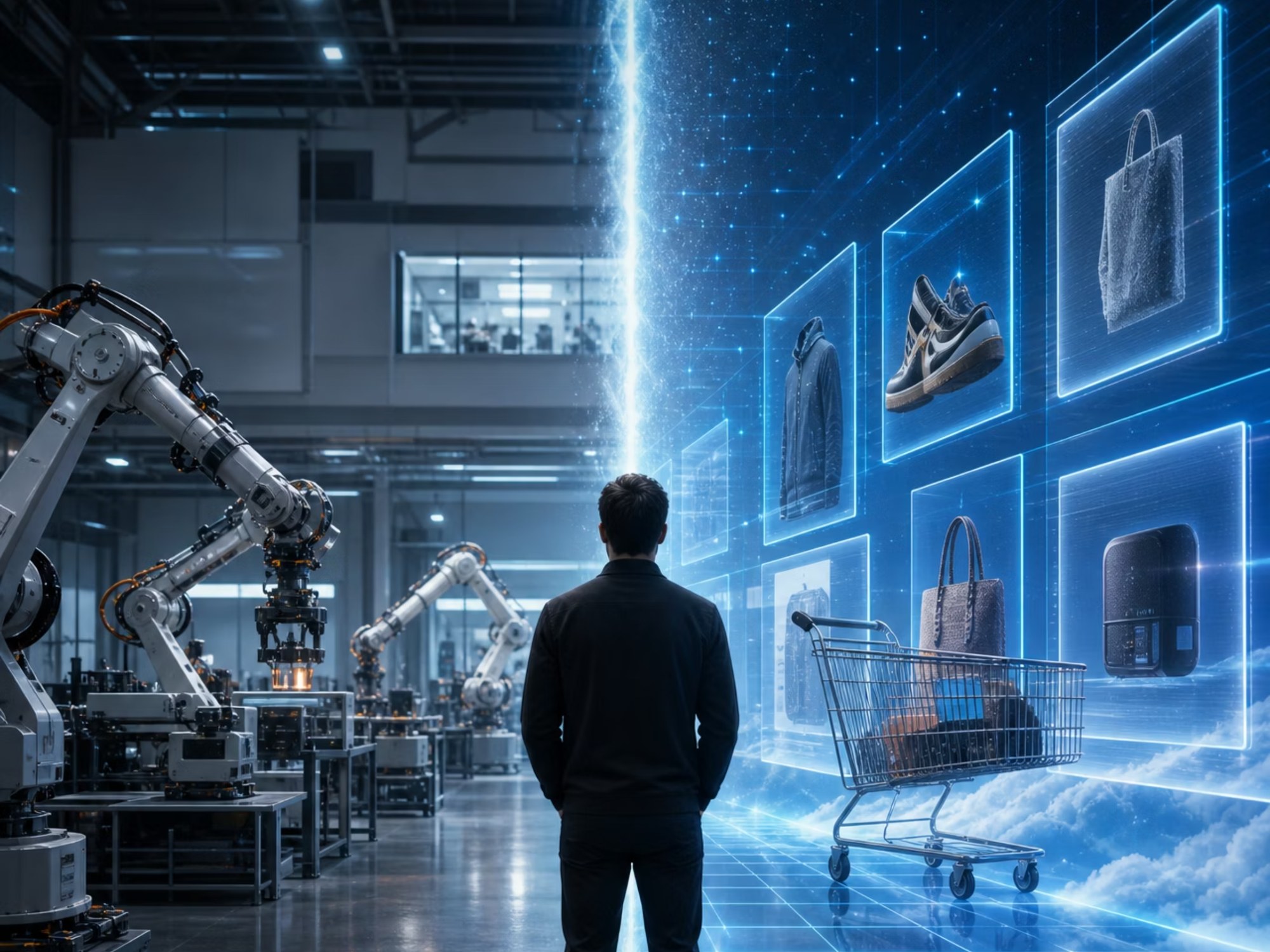
Simulate Before You Act: What Frontier AI Is Teaching DTC Brands About Conversion
World Labs just proved the thesis. Here's what it means for the brands spending real money on ads they haven't tested yet.
Fei-Fei Li just announced that World Labs — the spatial intelligence company she co-founded — built something that changes how robots learn.
They call it an R2S2R engine: real-to-sim-to-real. The idea is exactly what it sounds like. Instead of deploying a robot into a warehouse and watching it fail until it learns, you build a generative simulator of the physical world. The robot acts inside that simulation, fails safely, and learns what works. Only then does it act in the real world.
The result: robots that learn complex manipulation tasks with zero real-world training data, and teams that can predict which robotic policies will succeed or fail before deploying a single physical unit.
The simulator is the linchpin.
That was Fei-Fei's framing, and we think she's right. We think the same logic applies to commerce — a point our CTO, Armando Murga, raised on LinkedIn, the day the announcement went out.
The same principle, one layer up
World Labs is simulating the physical world so robots can predict real-world outcomes before acting. At eLLMo, we simulate the human buyer — so DTC brands can predict conversion outcomes before spending real ad dollars.
The parallel is a thesis, not a claim of technical equivalence. World Labs builds embodied AI for warehouses, labs, and homes. We build synthetic buyer agents for product pages and ad content. But the underlying logic is identical: simulate the world, predict what will happen, then act.
For a robot, the world is a shelf, a conveyor belt, a box that needs to be picked and packed. For a $30M DTC brand, the world is a buyer — a real person with a specific intent, navigating your product page, reading your copy, deciding whether to add to cart or leave. The question both teams are trying to answer is the same: will this work, before we commit to it?
Why DTC brands haven't had this — until now
For the last decade, DTC brands have operated in what we'd call the react-and-learn loop: launch the campaign, drive traffic, read the bounce rates, A/B test the headline, repeat.
Every signal comes from the real world, after the money is already spent. You find out a product page doesn't convert after you've driven $50,000 in traffic to it. You find out buyers are dropping at the third scroll after your ad agency has already wrapped the campaign. The feedback loop is slow, expensive, and backwards.
This wasn't a choice. Until recently, there was no way to simulate a buyer — to model how a specific human with specific intent would navigate your site and your content before any real dollars moved. AI changes that.
What buyer simulation actually means
When we say synthetic buyer simulation, we mean a digital twin of your customer: an agent trained on real buyer behavior, tuned to the commerce context, that navigates your site the way a real person would.
It reads your product page the way a buyer reads it — not the way your CMO reads it. It processes your ad copy the way someone on a phone, in 30 seconds, distracted, would process it. It surfaces where buyers get stuck, what signals change their answer, what would tip them from maybe to add to cart.
This is not analytics. Analytics tells you what happened. Simulation tells you what will happen — before it happens. The simulation runs before you touch the product page, before the campaign launches, before the spend goes out.
What we're seeing in practice
A Canadian healthcare company ran our buyer and AEO simulation to understand their content. AI brand visibility climbed 14%, surpassing competitors they'd been chasing for a year.
A DTC premium meat company ran it on a product page. Product clicks up 15.4%. Conversion up 10%. Bounce down 8.2%.
These are not A/B test results. They came from running a simulation first, identifying exactly what was broken, and fixing it before the traffic arrived.
The world Fei-Fei is describing
In her announcement, Fei-Fei noted that World Labs' simulator is policy- and embodiment-agnostic — meaning it doesn't care what kind of robot you have, or what task it's trying to perform. The simulator is the generalized layer beneath them all.
That's the right architectural instinct. The simulation layer is the most valuable part because it removes the dependency on real-world feedback cycles that are expensive and slow.
For commerce, the equivalent of policy-agnostic is brand-agnostic. The simulation runs against any product page, any ad creative, any buyer persona. The underlying layer — a commerce-tuned persona corpus trained on real buyer behavior — is what makes the simulation accurate at the individual intent level.
Gabriel Millien, commenting on Fei-Fei's post, raised the test that matters: does this hold up for hours, under real operational conditions, when things drift slightly from training? It's the right pressure point for robots. It's the right pressure point for buyer simulation too. A snapshot simulation run once before a campaign is useful. A continuously updated simulation that re-runs as your catalog changes, your copy updates, and your buyer context shifts — that's the linchpin.
What this means if you're a DTC brand spending on ads right now
You are already making decisions under uncertainty. The question is whether you want to reduce that uncertainty before you spend.
AI search has changed the buyer journey. Buyers are now forming brand preferences inside ChatGPT, Perplexity, and Google's AI Overviews before they ever click to your site. By the time they land on your product page, they have expectations set by an AI they interacted with two minutes ago.
Your page either confirms those expectations, or it doesn't. Simulation tells you which one it is before a real buyer finds out.
Frontier AI labs are converging on a single idea: you don't need to act in the real world to learn what works in the real world. Simulate the world. Predict the outcome. Then act. World Labs is proving it for robots. eLLMo is built on the same thesis — for the buyer standing between your brand and your next conversion.
*Related Links: World Labs' R2S2R engine announcement, via Armando Murga on LinkedIn, and the original announcement thread.*
See this in action on your page
eLLMo runs test buyers against your product page and returns a ranked list of what stops people from buying.
More from the blog