Agentic Commerce Protocols: A Technical Guide to UCP, ACP, MCP, and A2A

A comprehensive technical guide to the four protocol families that power agentic commerce: UCP, ACP, MCP, and A2A. Learn how to implement them without replatforming.

eLLMo Team
eLLMo Team
12 min read

Why Agentic Commerce Needs Protocols

When customers ask AI assistants for product recommendations, they expect accurate prices, real availability, and a path to purchase. When your systems speak a different language than each AI platform, you miss those conversations. Agentic commerce relies on interoperable protocols so AI assistants can discover, validate, and transact with your brand reliably.

eLLMo AI supports four complementary protocol families that work together to enable the complete agentic commerce workflow. Each protocol serves a specific purpose in the journey from discovery to transaction.

Protocol Capabilities at a Glance

MCP (Model Context Protocol)

Enables capability discovery and validation. AI assistants use MCP to understand what actions they can perform, what resources are available, and how to interact with your systems within defined consent boundaries.

UCP (Universal Commerce Protocol)

Standardizes product data across different platforms and formats. UCP ensures AI agents receive consistent, normalized product information including identity, pricing, availability, and policy details.

ACP (Agent Commerce Protocol)

Orchestrates negotiation and checkout flows. ACP handles the conversational commerce experience, from offer construction through payment authorization to fulfillment, maintaining state across multi-turn interactions.

A2A (Agent-to-Agent Protocol)

Enables cross-vendor delegation and coordination. When a purchase requires multiple vendors (shipping quotes, bundled products, etc.), A2A allows agents to coordinate securely while maintaining user consent.

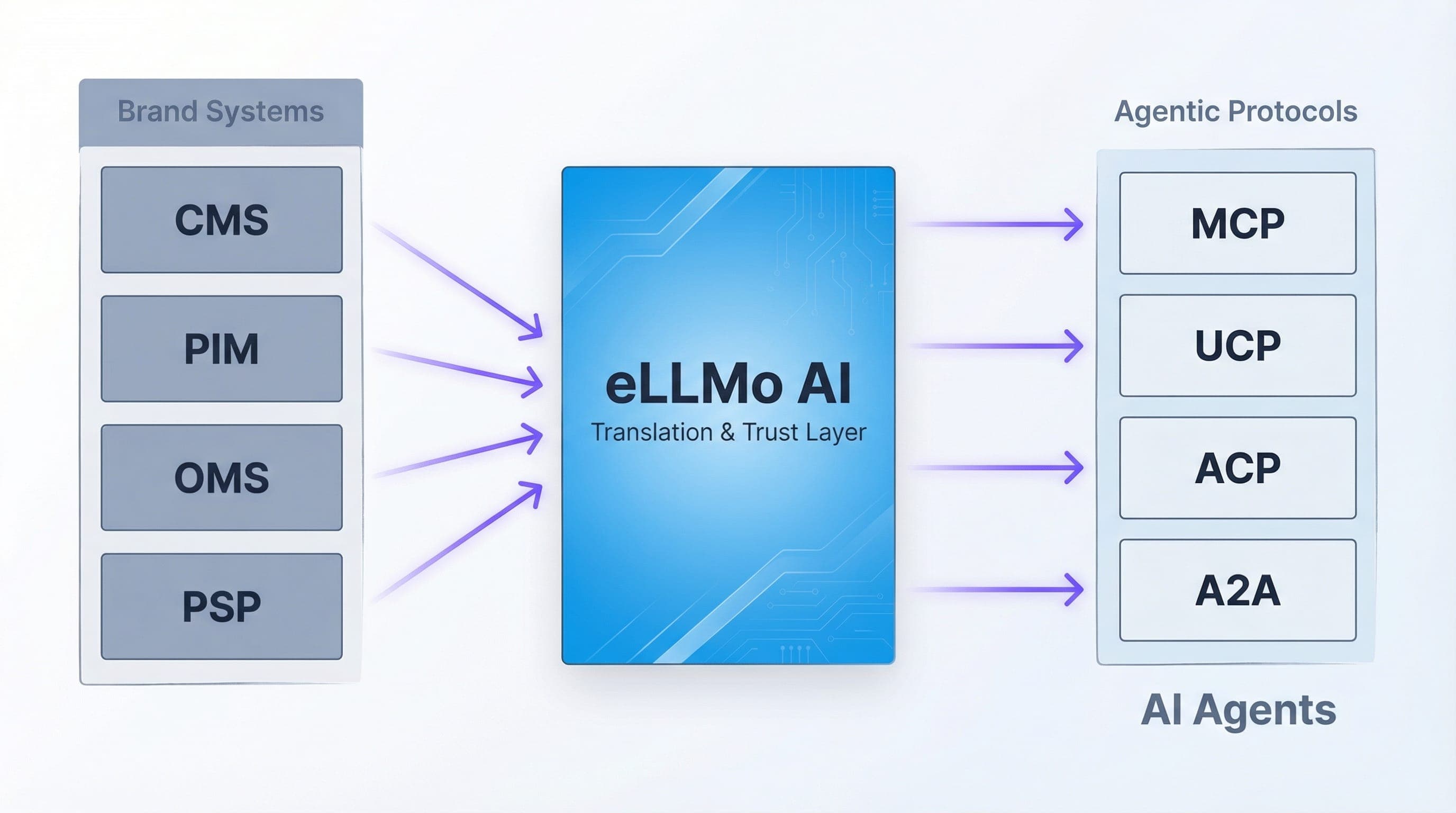
Layered architecture diagram showing brand systems connected to eLLMo AI translation layer, which connects to MCP, UCP, ACP, and A2A protocols, ultimately serving AI agents

eLLMo AI acts as a translation and trust layer between your existing systems and modern agentic commerce protocols

Why Standards-Based Protocols Matter

When brands rely on proprietary APIs for AI integration, they face a critical challenge: each AI platform requires custom integration work, creating maintenance overhead and vendor lock-in. Standards-based protocols solve this problem by providing a common language that works across multiple AI surfaces.

Model and assistant independence: By implementing open protocols, your catalog, pricing, and policies become interpretable by ChatGPT, Google AI, Perplexity, and future AI platforms without additional integration work. Your semantics stay durable as platforms evolve.

Trust and control: When AI assistants quote outdated prices or wrong product details, customers lose trust and you lose sales. Verified catalogs with audit trails keep answers consistent with your brand truth.

Time-to-value without replatforming: eLLMo AI activates protocol distribution in under four hours by translating protocol messages to your existing REST or GraphQL APIs. You keep your current CMS, PIM, OMS, and payment systems while becoming protocol-ready.

Understanding MCP: Capability Discovery and Governance

Model Context Protocol (MCP) establishes how AI assistants discover what capabilities your systems offer and how to invoke them within proper consent boundaries. Think of MCP as the handshake that precedes any commerce interaction.

When an AI agent connects to your brand through MCP, it receives a manifest describing available tools (like product search or inventory check), resources (like your product catalog), and prompts (like policy-aware response templates). The agent knows exactly what it can do and what information it can access, all governed by user consent.

Key MCP capabilities:

  • Tool registration with structured schemas defining inputs and outputs
  • Resource discovery with URI-based access to data sources
  • Prompt templates that ensure responses honor your business rules
  • Lifecycle management for enabling, disabling, or deprecating capabilities
  • Consent scopes that limit what actions agents can perform
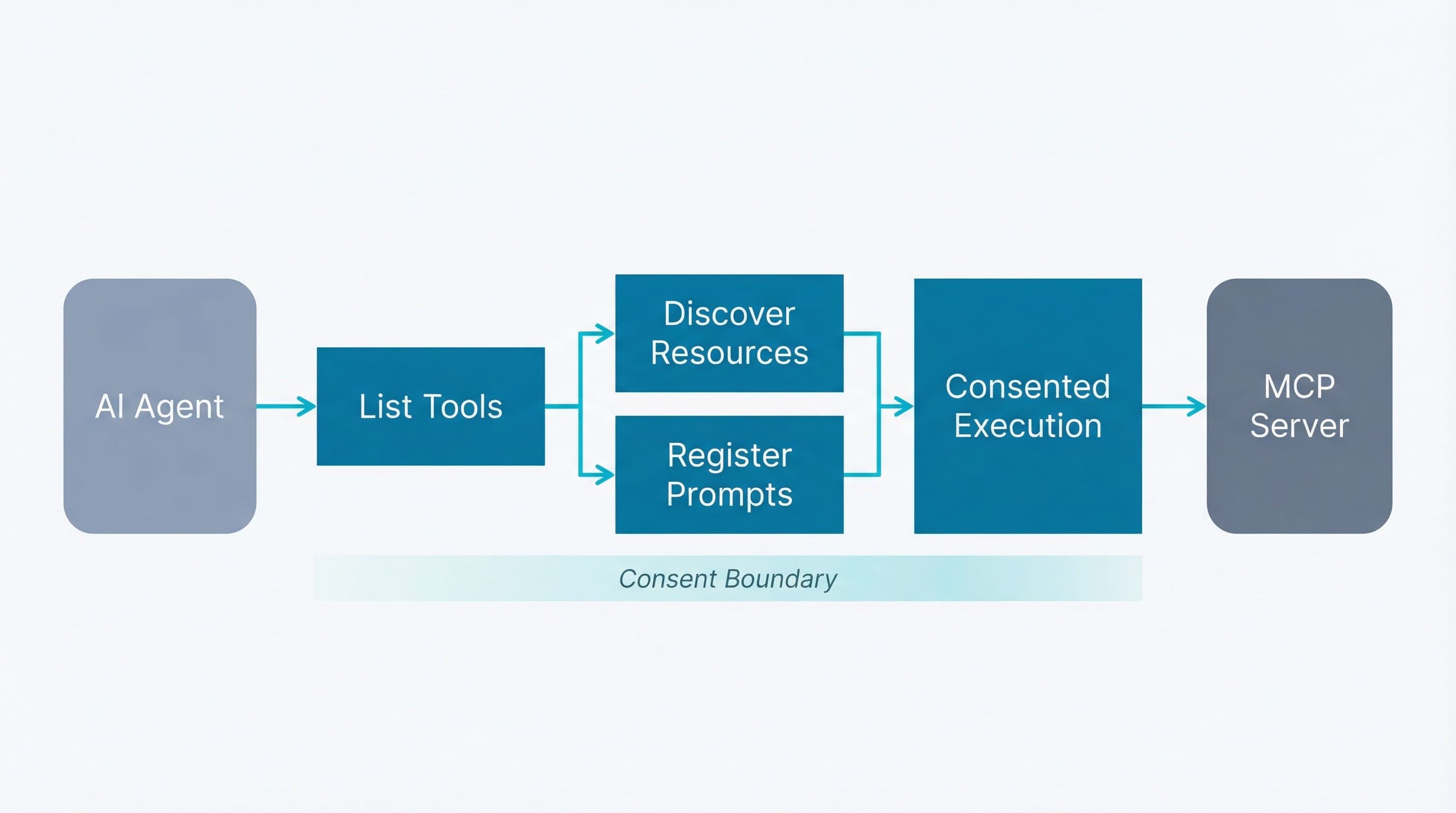
MCP capability discovery flow diagram showing tool listing, resource discovery, prompt registration, and consented execution

MCP enables AI agents to discover and use capabilities within defined consent boundaries

Here's an example MCP capability manifest showing how tools and resources are exposed:

{
  "tools": [
    {
      "name": "get_product",
      "description": "Fetch normalized product data by ID.",
      "inputSchema": {
        "type": "object",
        "properties": {
          "id": { "type": "string" }
        },
        "required": ["id"]
      }
    },
    {
      "name": "search_catalog",
      "description": "Search catalog by query and filters.",
      "inputSchema": {
        "type": "object",
        "properties": {
          "q": { "type": "string" },
          "filters": { "type": "object" }
        }
      }
    }
  ],
  "resources": [
    {
      "uri": "ellmo://catalog/products",
      "title": "Products",
      "mime": "application/json"
    }
  ],
  "prompts": [
    {
      "name": "answer_with_policies",
      "purpose": "Ensure responses honor return and shipping policies."
    }
  ]
}

UCP: Standardizing Product Data Across Platforms

Universal Commerce Protocol (UCP) solves the product data fragmentation problem. Different ecommerce platforms represent products differently. Shopify has one schema, WooCommerce another, and custom platforms vary widely. UCP provides a normalized, category-agnostic format that AI agents can reliably parse regardless of your underlying platform.

When an agent requests product information through UCP, it receives a consistent payload structure with identity (product IDs, variants), composition (materials, ingredients), specifications (dimensions, technical details), pricing (amount, currency, promotions), availability (in stock, backorder), and policy details (returns, shipping, memberships).

Critical UCP features:

  • Normalized attributes work across verticals (fashion, beauty, food, electronics)
  • Identity fields ensure the right product is referenced in conversations
  • Policy hooks connect to your actual terms so agents quote accurate conditions
  • Incremental updates via webhooks or polling keep data fresh
  • Versioned schemas allow evolution without breaking existing integrations
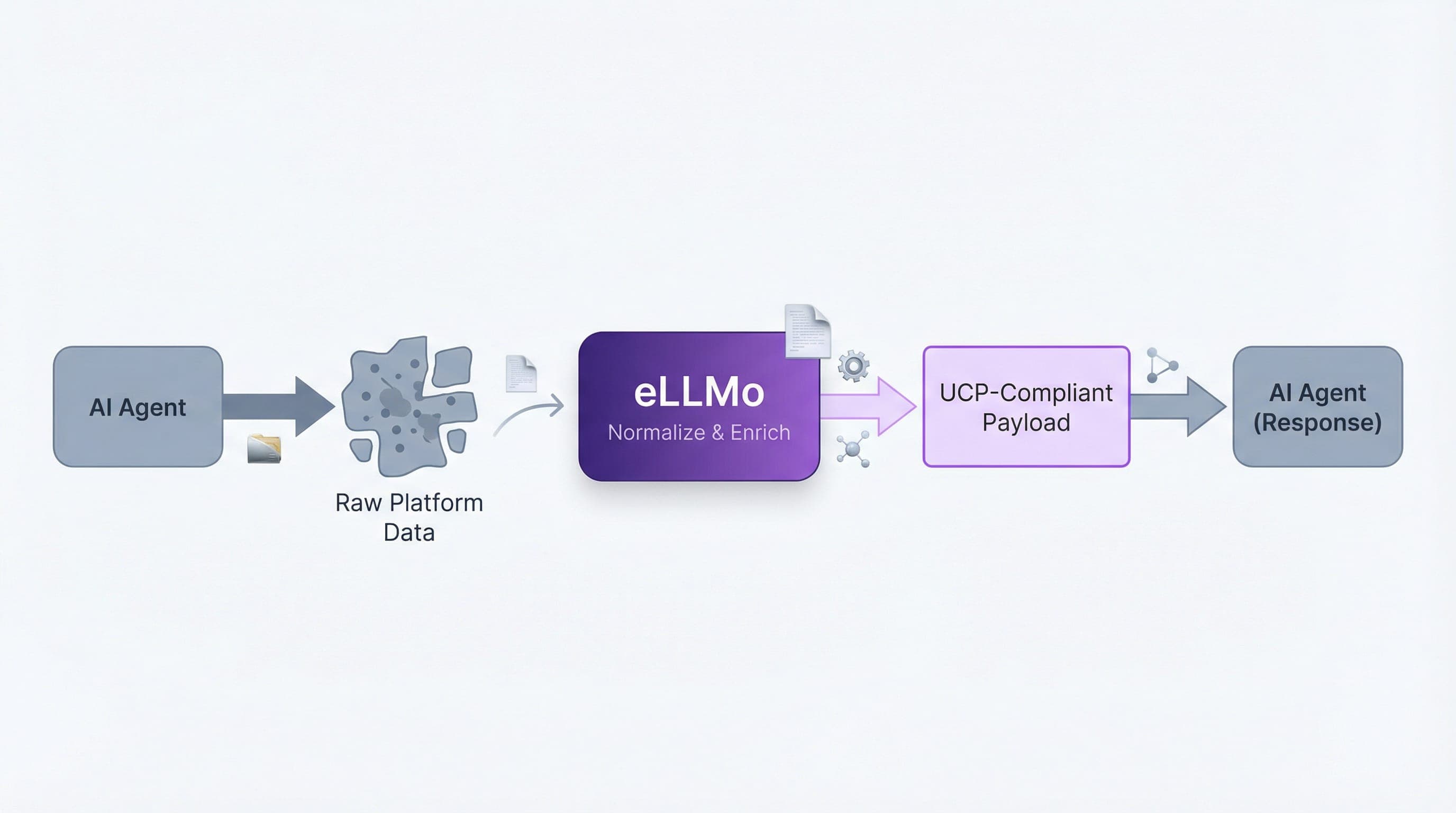
UCP product data normalization sequence showing agent request, eLLMo normalization and enrichment, and UCP-compliant response

UCP transforms platform-specific product data into a normalized format AI agents can reliably interpret

Example UCP product payload for a beauty product:

{
  "id": "prod-001",
  "name": "Hydrating Serum 30ml",
  "description": "Lightweight serum with hyaluronic acid and vitamin C.",
  "attributes": {
    "ingredientList": ["Hyaluronic Acid", "Vitamin C"],
    "skinType": "All",
    "size": "30ml"
  },
  "price": {
    "amount": 79.99,
    "currency": "USD"
  },
  "availability": "in_stock",
  "policy": {
    "returnWindowDays": 30,
    "membershipEligible": true
  },
  "updatedAt": "2026-02-19T12:00:00Z"
}

This structure works identically whether the underlying data comes from Shopify, WooCommerce, or a custom PIM. The agent sees consistent semantics every time.

ACP: Orchestrating Conversational Commerce

Agent Commerce Protocol (ACP) handles the transaction lifecycle in conversational commerce. Unlike traditional checkout flows where users click through predefined steps, ACP enables multi-turn negotiation where the agent and user can discuss options, apply promotions, adjust quantities, and confirm terms before finalizing the purchase.

ACP maintains conversational state across these interactions, tracking offers, counteroffers, payment authorization, and fulfillment coordination. When a customer asks an AI assistant to "add the serum to my cart and apply my membership discount," ACP orchestrates the entire flow while enforcing your business rules.

Core ACP capabilities:

  • Offer construction with line items, discounts, taxes, and shipping
  • Multi-turn negotiation preserving conversational context
  • Payment orchestration connecting to your existing payment gateway
  • Fulfillment coordination with order management systems
  • Promotion and membership rule enforcement during offer assembly
  • Audit trails for compliance and dispute resolution
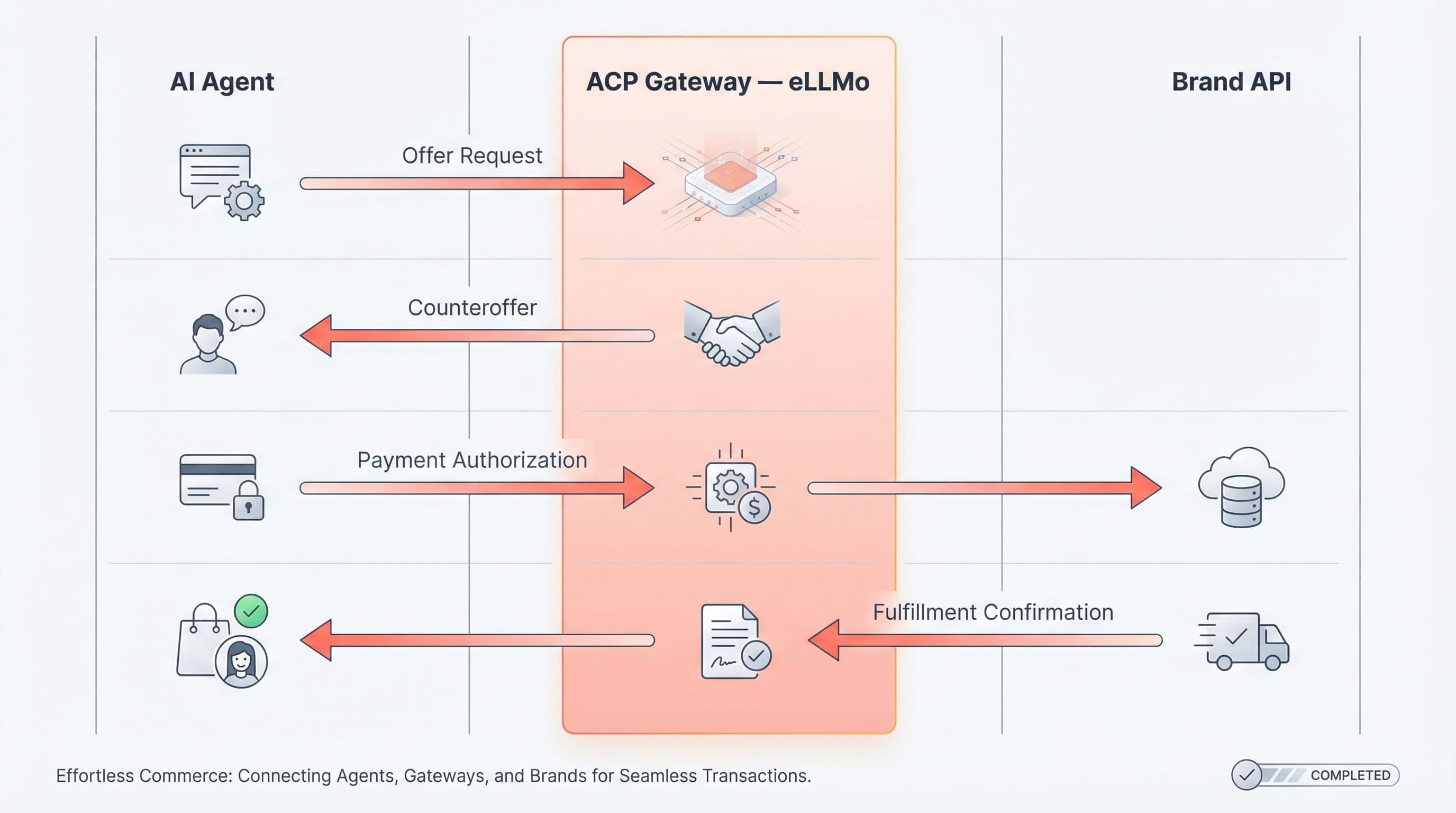
ACP negotiation swimlane diagram showing agent-eLLMo-brand API interactions during offer, counteroffer, payment authorization, and fulfillment

ACP orchestrates the full conversational commerce flow from negotiation through fulfillment

Example ACP offer message with applied discount:

{
  "type": "offer",
  "offerId": "off-789",
  "items": [
    {
      "productId": "prod-001",
      "qty": 1,
      "unitPrice": {
        "amount": 79.99,
        "currency": "USD"
      }
    }
  ],
  "discounts": [
    {
      "code": "WINTER10",
      "amount": {
        "amount": 8.00,
        "currency": "USD"
      }
    }
  ],
  "total": {
    "amount": 71.99,
    "currency": "USD"
  },
  "validUntil": "2026-02-29T23:59:59Z",
  "terms": {
    "shipping": "standard",
    "returns": "30d"
  }
}

The agent can present this offer to the customer, who might accept it, ask for expedited shipping, or request to add another item, all handled through subsequent ACP messages.

A2A: Enabling Cross-Vendor Coordination

Agent-to-Agent Protocol (A2A) becomes essential when a purchase involves multiple vendors or requires coordination between specialized agents. Imagine a customer asking for a gift bundle where the main product comes from your store but the gift wrapping and expedited shipping come from partners. A2A enables secure, consented delegation between agents.

A2A handles identity, authorization, rate limits, and signed messages to ensure cross-agent interactions remain secure and auditable. Each agent operates within defined delegation policies, and the user maintains control over which cross-vendor actions are permitted.

A2A use cases and features:

  • Shipping quote delegation when fulfillment partners have better rates
  • Bundled product assembly across multiple vendor catalogs
  • Subscription coordination when products come from different sources
  • Identity and authorization with signed message envelopes
  • Delegation policies defining what agents can request from each other
  • Idempotent retries and delivery guarantees for reliable coordination
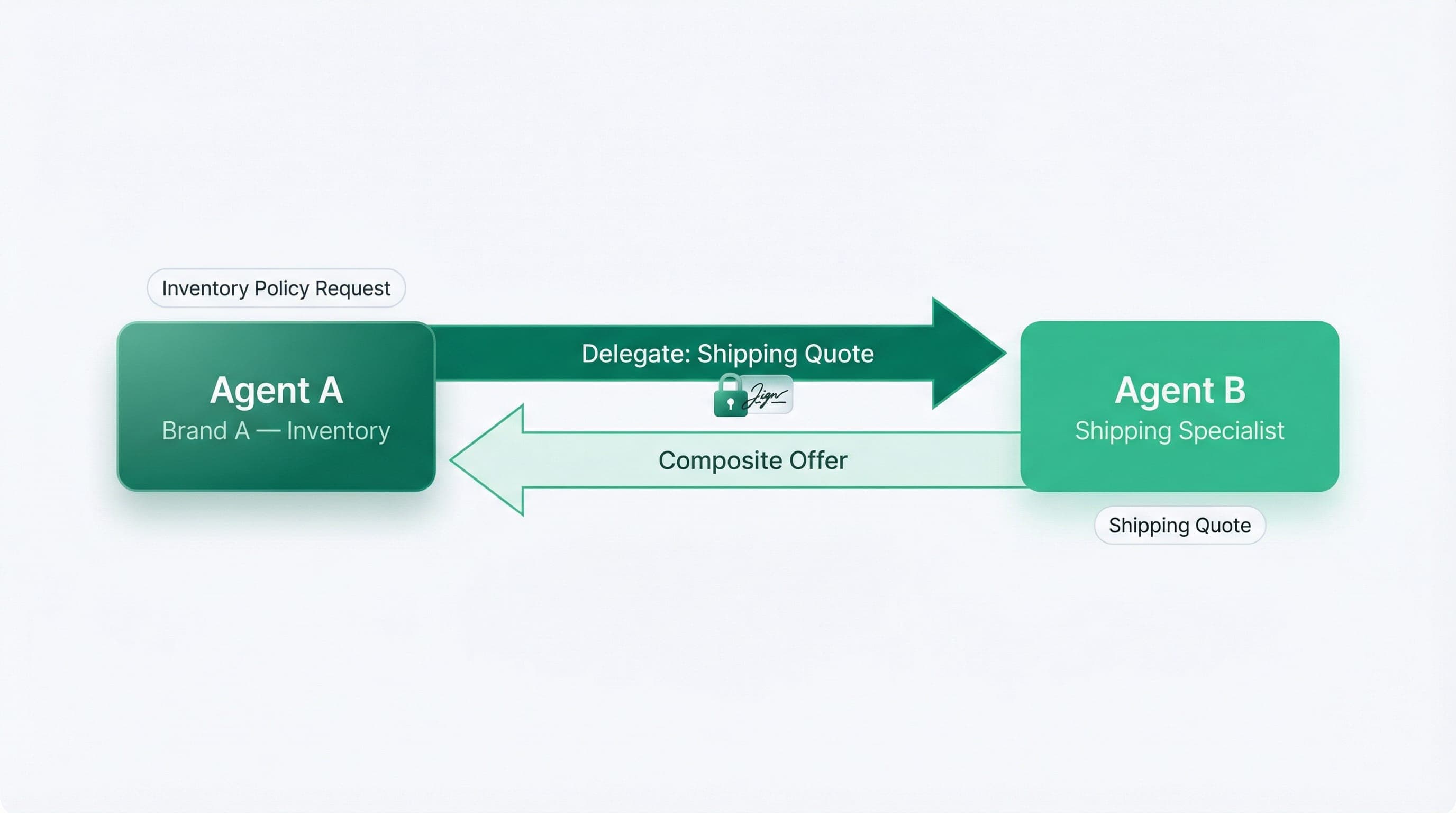
A2A agent delegation diagram showing two agents coordinating: Agent A gets inventory policy from Brand A, delegates shipping quote to Agent B, and returns composite offer

A2A enables secure coordination between agents serving different vendors or specializations

Example A2A context update requesting a shipping quote from a specialized agent:

{
  "from": "agent:concierge-1",
  "to": "agent:shipping-quote",
  "intent": "quote_request",
  "payload": {
    "items": [
      {
        "id": "prod-001",
        "qty": 1,
        "weightGrams": 200
      }
    ],
    "destination": {
      "country": "US",
      "postalCode": "94105"
    },
    "speed": "standard"
  },
  "traceId": "7f3e-4b2a-9c1d",
  "timestamp": "2026-02-19T12:10:00Z"
}

The shipping agent processes this request and returns a quote that the concierge agent can incorporate into the final offer to the customer.

Implementation Checklist by Protocol

Your roadmap to AI-first commerce

1

MCP Implementation

Register tools, resources, and prompts with clear capability metadata. Enforce consent scopes and lifecycle management (enable, disable, deprecate). Provide structured error and deprecation signals so agents can adapt gracefully.

2

UCP Implementation

Normalize product attributes ensuring identity, pricing, availability, and policy fields are present. Support incremental updates via webhooks or polling. Validate payloads against schema and version your attribute mappings.

3

ACP Implementation

Implement offer and counteroffer message handlers, persist conversational state. Integrate payment authorization and fulfillment orchestration. Log all decisions for audit trails and enforce promotion and membership rules during offer construction.

4

A2A Implementation

Authenticate and authorize peer agents with signed messages. Define delegation policies and rate limits for cross-agent requests. Ensure idempotent retries and delivery guarantees for reliable coordination.

To stay up to date, follow us on LinkedIn and sign up to our mailing list via our mailing list.

Getting Protocol-Ready in Four Steps

1

Prepare Product Truth with Product Intelligence

Use eLLMo's Product Intelligence module to extract, normalize, and enrich product data from your existing URLs and feeds. Establish policy hooks for promotions, memberships, shipping, and returns so agent responses reflect your actual terms.

2

Optimize URLs for AI Visibility

Run URL Intelligence to score your pages for reachability, semantic relevance, structured data quality, and performance. Prioritize high-impact URLs, deploy recommended fixes, and track rank movement over time.

3

Activate Protocols via eLLMo Translation Layer

eLLMo translates protocol messages to your existing REST or GraphQL APIs. Start with MCP for capability discovery, add UCP for product data, layer in ACP for transactions, and enable A2A when you need cross-vendor coordination. No replatforming required.

4

Measure and Iterate with a 30/60/90-Day Roadmap

Instrument assistant-mediated outcomes including appearances in organic AI answers and completed agent checkouts. Maintain a phased roadmap expanding catalog coverage, protocol breadth, and governance reviews as you scale.

Protocol Selection: When to Use Each

You do not need to implement all four protocols immediately. Start with the capabilities that match your current business needs and expand incrementally.

Start with MCP and UCP when your primary goal is making your catalog discoverable and interpretable by AI assistants. This foundation enables organic appearances in AI-generated answers when users ask product questions.

Add ACP when you want to enable conversational commerce transactions, not just discovery. ACP becomes valuable when you see assistant-driven traffic converting and want to own the checkout experience within the conversational flow.

Enable A2A when your products require coordination with other vendors or specialized fulfillment services. A2A is essential for marketplaces, subscription bundles, and any scenario where multiple parties need to coordinate on a single customer transaction.

Common Questions About Protocol Implementation

Do we need to replatform to become protocol-ready?

No. eLLMo AI acts as a translation layer that converts protocol messages to calls against your existing REST or GraphQL APIs. Your CMS, PIM, OMS, and payment systems remain unchanged.

How fast can we go live with protocol support?

Initial activation takes under four hours for lightweight setup, product enrichment, and protocol endpoint configuration. You can then iterate by priority, expanding catalog coverage and protocol features incrementally.

Can we control promotions and memberships in agent flows?

Yes. Policy hooks are enforced during offer construction and checkout orchestration, ensuring agents respect your actual business rules including member pricing, promotional codes, and eligibility requirements.

How do we measure success with protocol-based distribution?

Track organic answer appearances (how often AI assistants reference your products), protocol health metrics (response times, error rates), and completed agentic transactions. URL Intelligence provides ranking and deployment tracking for AI visibility.

What happens when your product data only works with one AI platform? You miss every other channel. Standards-based protocols provide the foundation for durable AI commerce integration. By implementing MCP, UCP, ACP, and A2A through eLLMo's translation layer, you gain multi-platform AI distribution without replatforming. Start with discovery and product data (MCP + UCP), expand to transactions (ACP) as traffic converts, and enable cross-vendor coordination (A2A) when your business model requires it.

Ready to Become Protocol-Ready?

Activate agentic commerce protocols in under four hours with eLLMo AI. No replatforming required.

Join Our Mailing List

Stay tuned. Join our mailing list to be among the first to experience the future of search. We'll be in touch with news and updates.

We respect your privacy. Unsubscribe at any time.

Agentic Commerce Protocols: A Technical Guide to UCP, ACP, MCP, and A2A | eLLMo AI Protocols